Middle Ear Barotrauma in Hyperbaric Oxygen Therapy: Incidence, Grading and Prevention
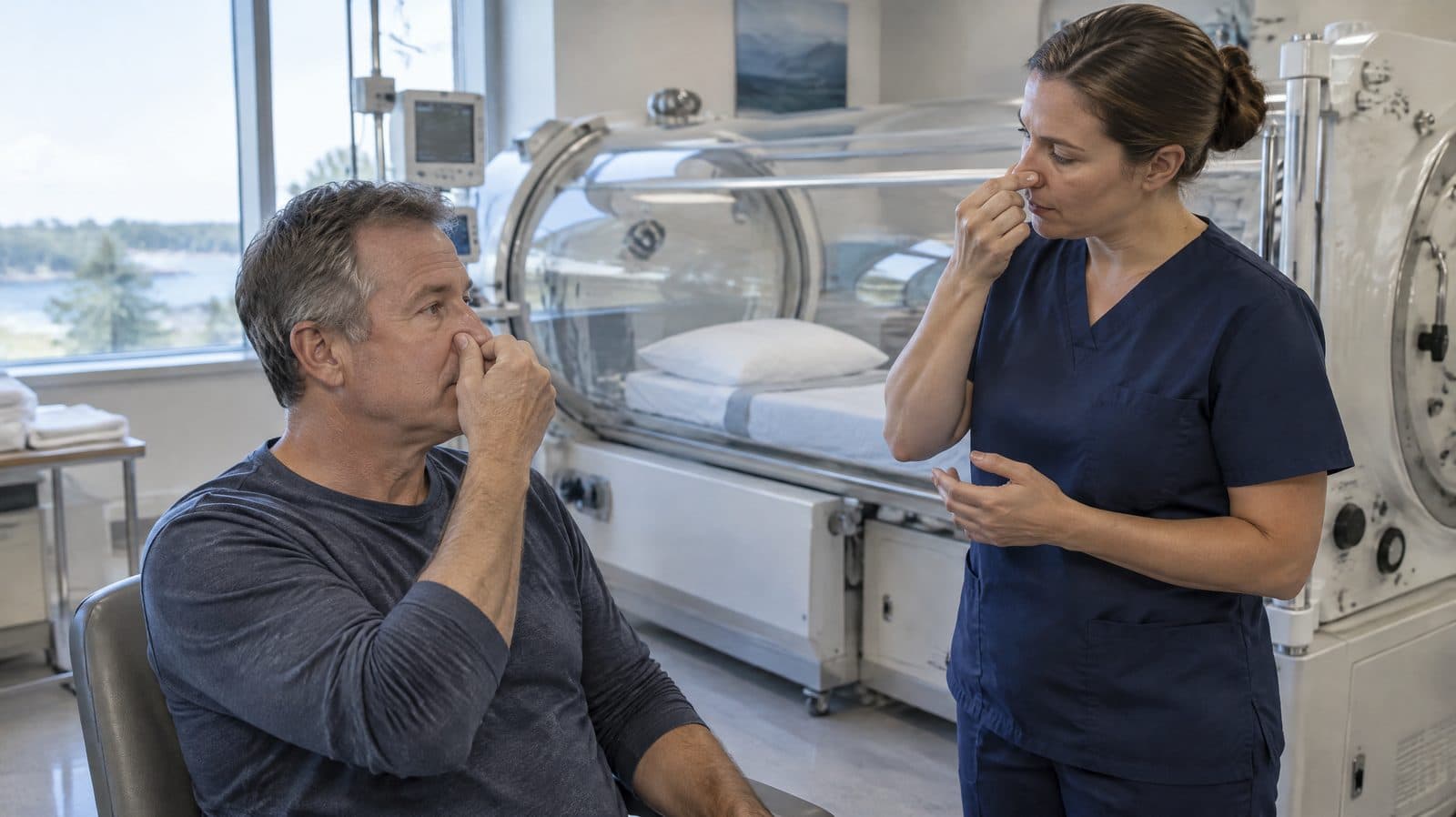
Middle ear barotrauma (MEB) is the most common side effect of hyperbaric oxygen therapy. It happens when the air space behind the eardrum fails to keep up with the rising pressure in the chamber, and it ranges from a slightly red eardrum to blood behind it or, rarely, a perforation. This page collects what the clinical literature says about how often it happens, how it is graded, who is most at risk, and which preventive measures have held up when they were tested.
It is written for patients, families and chamber operators who want the evidence in one place. It does not replace an examination: any ear pain during or after a session should be assessed by the treating hyperbaric team. For background on the treatment itself, see our overview of hyperbaric oxygen therapy.
Why the Middle Ear Is the Weak Point
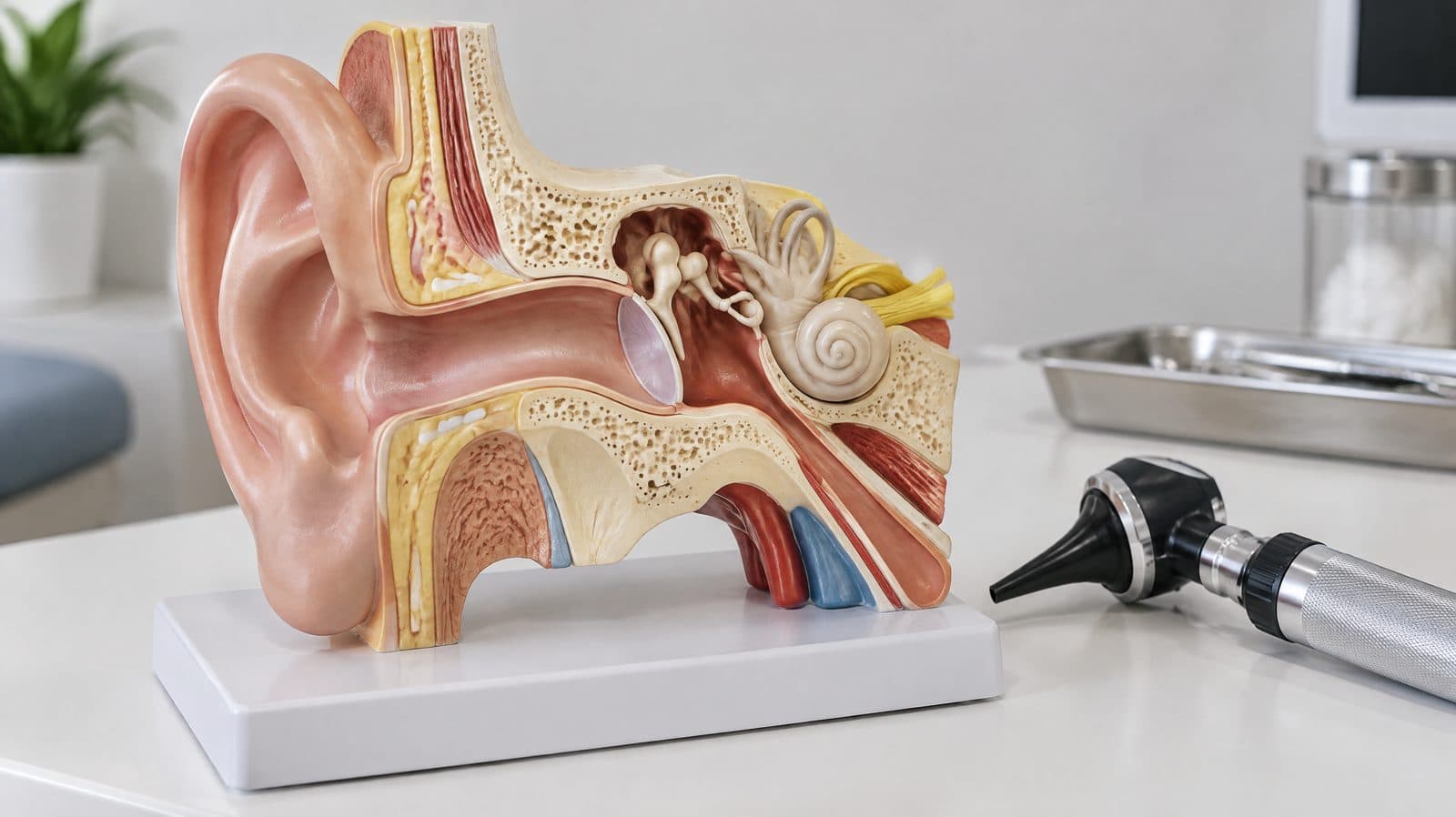
The middle ear is a small, rigid, air-filled space closed off by the eardrum on one side. Its only connection to the outside air is the Eustachian tube, which runs to the back of the nose and is normally closed. It opens briefly when you swallow, yawn or move the jaw, which is how the pressure behind the eardrum is kept equal to the pressure outside.
Boyle's law explains the problem. At a constant temperature, the volume of a gas falls in proportion to the absolute pressure: doubling the pressure from 1 to 2 atmospheres absolute (ATA) halves the volume. As a chamber is compressed, the air in the middle ear shrinks, the eardrum is pulled inward and the lining of the cavity swells and bleeds if the gap is not closed by air entering through the Eustachian tube. The StatPearls review of hyperbaric physics describes Boyle's law as the foundation for understanding barotrauma in both diving and hyperbaric medicine.
The relative change is largest at the start of a treatment. Going from 1.0 to 1.5 ATA reduces the gas volume by a third; going from 2.0 to 2.5 ATA reduces it by only a fifth. That is why ear discomfort is usually felt in the first minutes of compression, and why people who equalize well at the beginning rarely have trouble later. Our guide to hyperbaric pressure units converts these pressures into psi, feet of seawater and kilopascals.
How Often It Happens
Reported rates vary enormously because studies define barotrauma differently, examine ears at different times and treat different patients. A review in Advances in Wound Care (Heyboer and colleagues, 2017) put the range at roughly 2% to 84% in patients who are not intubated and up to 94% in intubated patients. The main studies behind those figures are summarized below.
| Study | Setting | Key finding |
|---|---|---|
| Heyboer et al., 2014 (Undersea Hyperb Med) | Retrospective review, 236 patients, 4,981 treatments, academic level 1 trauma center | Overall MEB incidence 43.2%. 84% of cases were minor (TEED 1 or 2). No difference between compression rates; TEED 4 injuries were more frequent in intubated patients. |
| Bessereau et al., 2010 (Undersea Hyperb Med) | Prospective study, 130 patients in a multiplace chamber, mostly emergency indications | MEB in 13.6% of patients (12.4% of conscious and 24.4% of intubated patients). Repeated treatments and difficulty equalizing were the risk factors. |
| Blanshard et al., 1996 (Clin Otolaryngol) | Prospective study, 82 patients on long courses for chronic conditions | 29.3% needed ventilation tubes for ear pain, more often after head and neck radiation. Of the remaining ears examined, 8% showed TEED 3 or 4 changes. |
| Presswood et al., 1994 (Laryngoscope) | Retrospective review, 267 patients | Ear complications in 94% of patients with an artificial airway versus 45.8% without; tympanostomy tubes in 61% versus 21.3%. |
| Fiesseler et al., 2006 (Undersea Hyperb Med) | Retrospective review, 325 patients, 2000–2004 | 15% of all patients needed tympanostomy tubes during their course; 29% of patients treated for nasopharyngeal radiation injury. |
| Lee et al., 2025 (Yonsei Med J) | Retrospective cohort, monoplace chambers | Altered mental status (OR 2.50) and emergency treatment status (OR 6.75) were independent risk factors for MEB. |
Two patterns run through the data. First, most barotrauma is minor: in the largest single-center review, 84% of cases were the two lowest grades and none involved a ruptured eardrum. Second, the people at highest risk are those who cannot equalize on their own, whether because they are intubated, sedated or unconscious, or because their Eustachian tube does not work well after radiation to the head and neck.
A 2023 meta-analysis of controlled trials in Frontiers in Medicine (Zhang and colleagues) found ear discomfort to be the most frequently reported adverse effect of hyperbaric oxygen, with a risk ratio of 3.38 compared with sham or conventional treatment.
How It Is Graded
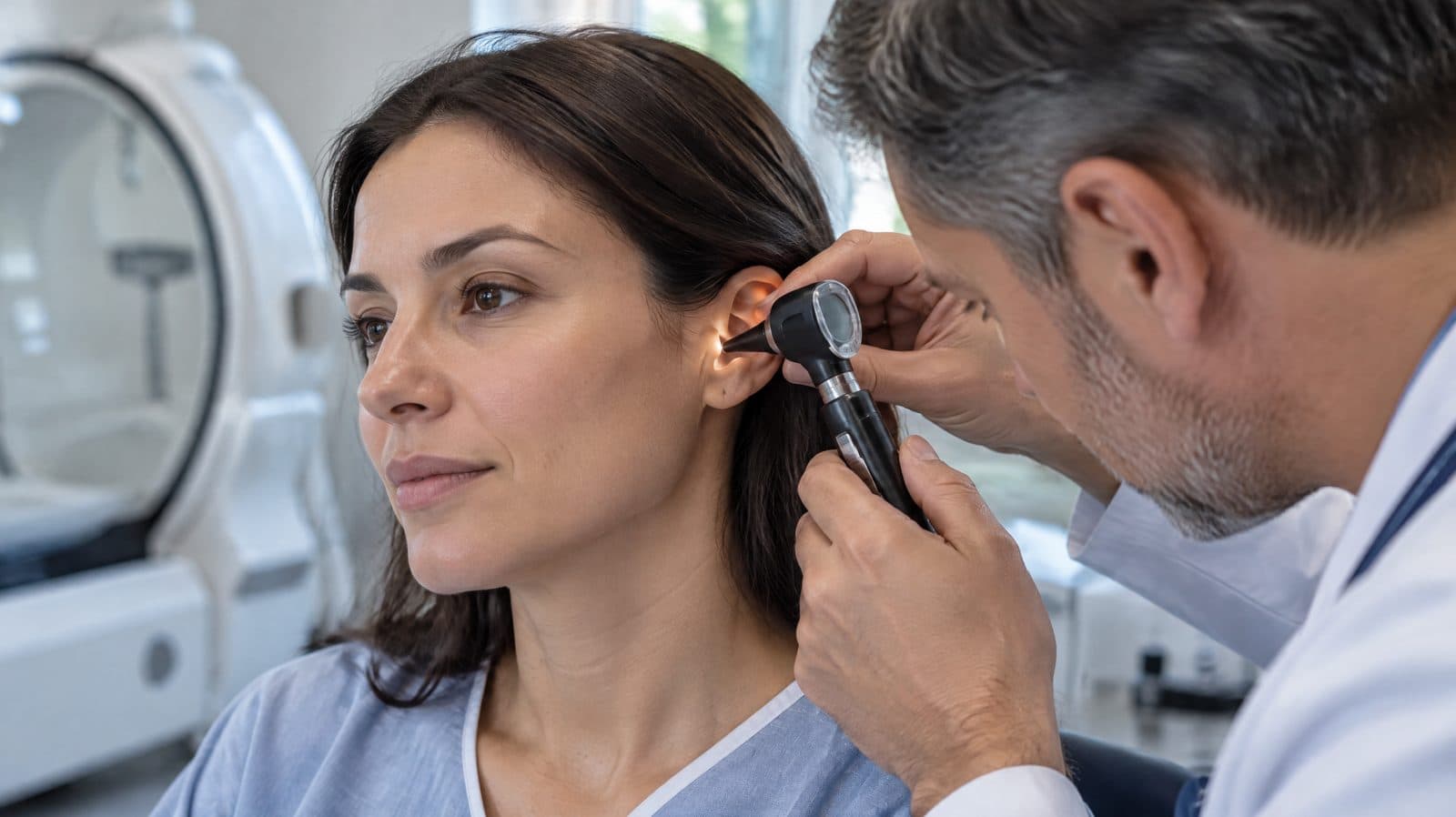
The classic system was described by Teed in 1944 in naval submarine personnel and later modified. It grades what the examiner sees through an otoscope, from 0 to 5. The modified Teed scale is still the one most studies report.
| Grade | Otoscopic finding |
|---|---|
| 0 | Symptoms without visible signs |
| 1 | Redness and retraction of the eardrum |
| 2 | Grade 1 plus slight bleeding within the eardrum |
| 3 | Grade 1 plus gross bleeding within the eardrum |
| 4 | Dark, bulging eardrum with free blood in the middle ear (hemotympanum), sometimes a fluid line or bubbles |
| 5 | Perforation of the eardrum |
| Grade | Finding |
|---|---|
| 0 | Ear symptoms with no visible signs of trauma |
| 1 | Redness of the eardrum, or fluid or air trapped behind it |
| 2 | Perforation of, or bleeding from, the eardrum |
In 2015 O'Neill and Weitzner proposed a simpler three-level system in Undersea and Hyperbaric Medicine, arguing that the Teed scale was never designed to guide treatment decisions and gives inconsistent results between observers. Each O'Neill grade is tied to a suggested action, which makes it easier for every member of the hyperbaric team, not only physicians, to use it the same way.
Who Is Most at Risk
- People who cannot equalize on their own. Intubated, sedated, unconscious or confused patients cannot swallow or perform a Valsalva maneuver on request. Presswood's series found ear complications in 17 of 18 patients with an artificial airway.
- Emergency patients. In a 2025 monoplace cohort, altered mental status and emergency treatment status were independent risk factors, with odds ratios of 2.50 and 6.75.
- Head and neck radiation. Radiation can scar the Eustachian tube. Blanshard and Fiesseler both found higher rates of ventilation tube placement in these patients, reaching 29% after nasopharyngeal radiation.
- Anyone who struggles to equalize in the first session. Bessereau's study identified difficulty with pressure equalization and repeated treatments as the main risk factors in conscious patients.
- Congestion on the day. A cold, allergy flare or sinus infection narrows the Eustachian tube. Most programs ask patients to report these before compression rather than push through.
Prevention: What Works and What Does Not
Baseline exam and coaching
The standard of care described by O'Neill and Weitzner is an otoscopic exam before the first treatment, repeated whenever a patient has symptoms during compression or decompression. Heyboer's 2017 review concluded that education, practice and active coaching during compression help reduce cases. In practice that means teaching patients to equalize early and often, before they feel pressure, rather than waiting for pain.
Equalization techniques
- Swallowing, ideally with a sip of water, opens the Eustachian tube naturally and is the gentlest method.
- Jaw movements and yawning work for many people and can be repeated continuously.
- The Toynbee maneuver: swallowing while pinching the nose closed.
- A gentle Valsalva maneuver: pinching the nose and blowing softly against it. Forceful blowing should be avoided because it can injure the inner ear.
Slower or reshaped compression
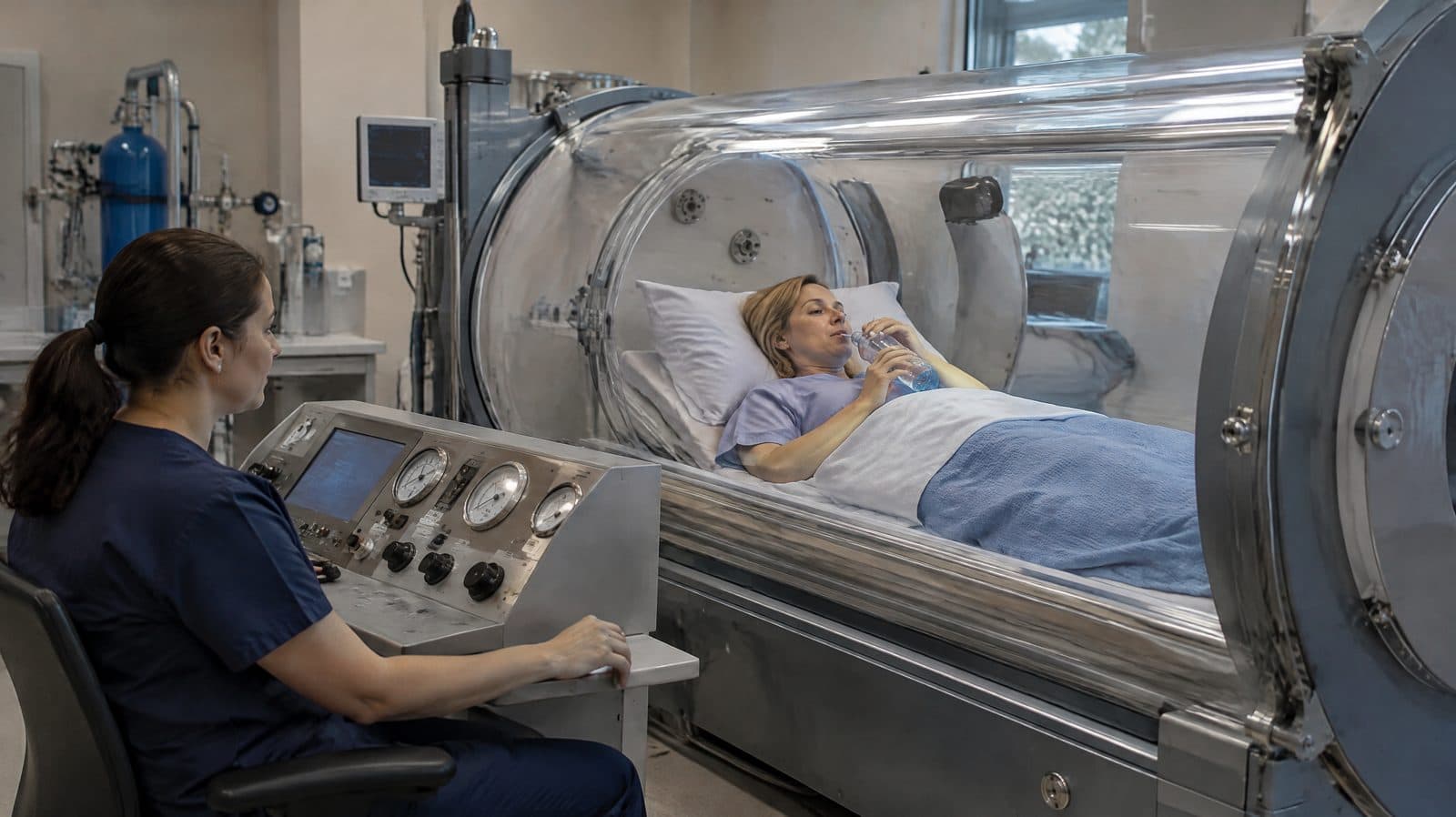
Compression speed is the variable operators control most directly, but the evidence is mixed. Heyboer's 2014 review found no difference in barotrauma between compression rates and supported a standard of 2 psi per minute. A prospective study by Varughese and colleagues in 2019, covering 2,807 elective treatments to 45 feet of seawater in a multiplace chamber, found fewer stops for symptomatic Eustachian tube dysfunction with a 15-minute linear compression than with a 10-minute one. Whatever the profile, the most important rule is that compression stops or reverses as soon as a patient reports difficulty.
Decongestants
Oral pseudoephedrine reduces ear problems in divers and air travelers, so it has long been used before hyperbaric treatment. When it was finally tested properly, it did not help. A randomized, double-blind, placebo-controlled trial at the University of Maryland published in Undersea and Hyperbaric Medicine in 2025 found no difference between pseudoephedrine and placebo in ear pain, eardrum injury or the use of rescue medication before a first multiplace treatment.
Ear tubes
For patients who cannot equalize at all, the definitive solution is a small opening in the eardrum that keeps the middle ear at chamber pressure: a myringotomy or a tympanostomy (ventilation) tube placed by an ear, nose and throat surgeon. Tubes are commonly placed before treatment in intubated patients and are added during a course when repeated barotrauma interrupts therapy. A simple myringotomy can heal over within days, so tubes are preferred when a long course is planned.
If It Happens
The first response is mechanical: stop compression, reduce the pressure slightly until the discomfort eases, try equalizing again and then continue slowly. If that fails, the session is ended and the ear is examined. Most low-grade injuries settle within days, and treatment can usually resume once the patient can equalize. Fluid behind the eardrum takes longer and may need a pause in treatment or tubes.
Two warning signs need same-day medical review: sudden hearing loss, ringing that does not fade, or vertigo, which can indicate inner ear barotrauma rather than a middle ear problem, and any discharge or bleeding from the ear canal. Pressure-related symptoms can also affect the sinuses and, rarely, the teeth. Other side effects of treatment, including oxygen toxicity, have different causes and are covered separately.
Does the Type of Chamber Matter?
The physics are identical in every chamber, so barotrauma occurs in monoplace and multiplace chambers alike. What differs is how the team can respond. In a multiplace chamber an attendant can coach a patient face to face and the pressure can be adjusted for the whole group; in a monoplace the operator coaches through an intercom and controls the pressure for one patient. Lower-pressure portable chambers involve a smaller total pressure change, but the steepest part of the volume curve is near the surface, so a person who cannot equalize will still feel it.
Frequently Asked Questions
Is ear pain in a hyperbaric chamber normal?
A feeling of fullness during compression is normal and clears when you equalize. Sharp or increasing pain is not: it means the middle ear is not equalizing, and you should tell the operator straight away so compression can be paused or reversed.
Can middle ear barotrauma happen during decompression?
It is far less common. On the way down in pressure the expanding air in the middle ear usually vents through the Eustachian tube without effort. Most injuries happen during compression, and most of those in the first part of it.
Do decongestants prevent it?
Not reliably. In a randomized, placebo-controlled trial published in 2025, pseudoephedrine given 45 minutes to 2 hours before a first multiplace treatment did not reduce ear pain, eardrum injury or the need for rescue medication.
How long does it take to heal?
Minor grades usually settle within days once pressure exposure stops or the person learns to equalize. Fluid behind the eardrum can take longer, and a perforation needs medical follow-up. Treatment is usually paused until the ear has been checked.
Does a mild 1.3 ATA chamber carry the same risk?
The mechanism is the same, and the steepest volume change happens near the surface, so people who struggle to equalize still feel it at low pressure. The total pressure change is smaller, though, so the injury pattern is generally milder.
References
- Heyboer M 3rd, Sharma D, Santiago W, McCulloch N. Hyperbaric oxygen therapy: side effects defined and quantified. Adv Wound Care. 2017;6(6):210–224. PMC5467109
- Heyboer M 3rd, Wojcik SM, Grant WD, Chambers P, Jennings S, Adcock P. Middle ear barotrauma in hyperbaric oxygen therapy. Undersea Hyperb Med. 2014;41(5):393–397. PMID 25558548
- Bessereau J, Tabah A, Genotelle N, Français A, Coulange M, Annane D. Middle-ear barotrauma after hyperbaric oxygen therapy. Undersea Hyperb Med. 2010;37(4):203–208. PMID 20737927
- Blanshard J, Toma A, Bryson P, Williamson P. Middle ear barotrauma in patients undergoing hyperbaric oxygen therapy. Clin Otolaryngol Allied Sci. 1996;21(5):400–403. PMID 8932942
- Presswood G, Zamboni WA, Stephenson LL, Santos PM. Effect of artificial airway on ear complications from hyperbaric oxygen. Laryngoscope. 1994;104(11 Pt 1):1383–1384. PMID 7968168
- Fiesseler FW, Silverman ME, Riggs RL, Szucs PA. Indication for hyperbaric oxygen treatment as a predictor of tympanostomy tube placement. Undersea Hyperb Med. 2006;33(4):231–235. PMID 17004409
- Lee YS, et al. Risk factors associated with middle ear barotrauma in patients undergoing monoplace hyperbaric oxygen therapy. Yonsei Med J. 2025;66(5):302–309. PMC12041396
- O'Neill OJ, Weitzner ED. The O'Neill grading system for evaluation of the tympanic membrane: a practical approach for clinical hyperbaric patients. Undersea Hyperb Med. 2015;42(3):265–271. PMID 26152108
- Varughese L, O'Neill OJ, Marker J, Smykowski E, Dayya D. The effect of compression rate and slope on the incidence of symptomatic Eustachian tube dysfunction leading to middle ear barotrauma: a phase I prospective study. Undersea Hyperb Med. 2019;46(2):95–100. PMID 31051053
- Moayedi S, Gizaw A, Sweet S, Sethuraman K, Witting M. Pseudoephedrine prophylaxis does not prevent middle ear barotrauma in hyperbaric oxygen therapy. Undersea Hyperb Med. 2025;52(2):101–107. PMID 40819351
- Zhang Y, Zhou Y, Jia Y, Wang T, Meng D. Adverse effects of hyperbaric oxygen therapy: a systematic review and meta-analysis. Front Med. 2023;10:1160774. PMC10232961
- Jones MW, Brett K, Han N, Cooper JS, Wyatt HA. Hyperbaric physics. StatPearls. NCBI Bookshelf. NBK448104
This page is a general reference and is not medical advice. Ear pain during or after hyperbaric treatment should be assessed by the treating hyperbaric team.
ATA, psi, fsw, msw and kPa explained, with conversion tables.
The other dose-related side effect of hyperbaric oxygen.
How the two chamber formats differ in staffing, pressure and patient care.