Hyperbaric Pressure Units Explained: ATA, psi, fsw, msw and kPa
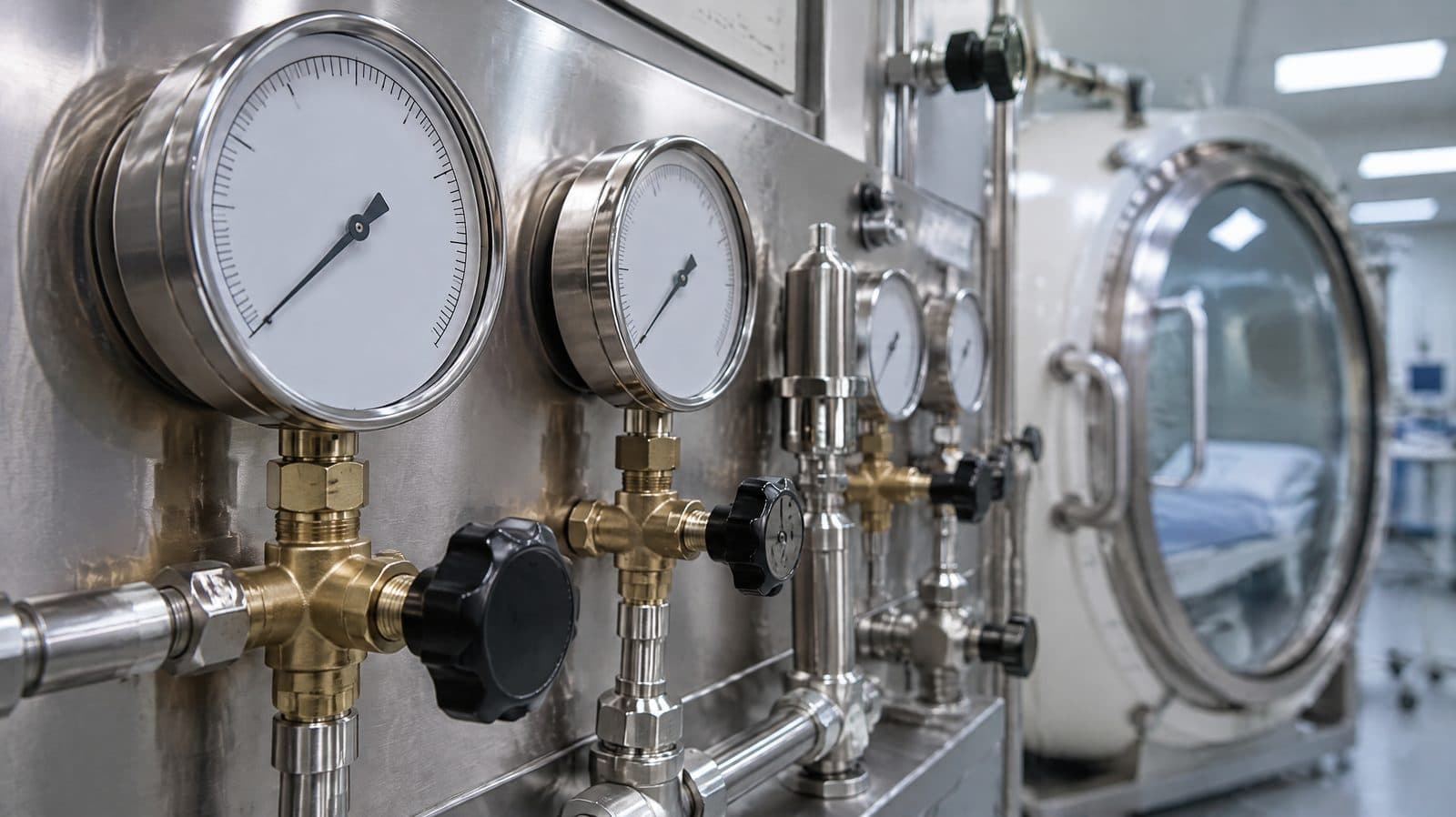
A hospital protocol says 2.4 ATA. A Navy treatment table says 60 feet. A home chamber brochure says 4 psi. A European data sheet says 200 kPa. All four describe the same thing, the pressure inside a hyperbaric chamber, in units that come from different traditions. This page explains each unit, shows how to convert between them, and puts the common treatment pressures side by side.
It is a reference for patients, students and anyone comparing chamber specifications. For the treatment itself, see our overview of hyperbaric oxygen therapy and the guide to hyperbaric chamber types.
Absolute Pressure vs Gauge Pressure
Every pressure figure is either absolute or relative to the surrounding air. Absolute pressure counts from a perfect vacuum, so at sea level we already sit at one atmosphere. Gauge pressure counts from the surrounding air, which is what most mechanical gauges show: a gauge on a chamber at sea level reads zero before compression even though there is one atmosphere inside.
The rule that connects them is simple: absolute pressure = gauge pressure + ambient pressure. At sea level the ambient pressure is 1 atmosphere, so 1 atmosphere of gauge pressure is 2 atmospheres absolute. Medical protocols use absolute pressure because the body responds to the total pressure, not to the difference shown on a dial. The StatPearls chapter on hyperbaric physics gives the classic diving example: at 20 meters of seawater a diver is under 2 atmospheres of water plus 1 atmosphere of air, an absolute pressure of 3 ATA.
You will see the distinction written into the unit names. psia means absolute and psig means gauge; ATA means atmospheres absolute, while atg or plain "atm above ambient" means gauge.
The Units, One by One
- Atmosphere (atm) and ATA. One standard atmosphere is defined as exactly 101,325 pascals, according to the NIST Guide to the SI. ATA is that unit counted from vacuum. It is the standard unit of clinical hyperbaric medicine.
- Kilopascal (kPa) and bar. The SI units. 1 atm = 101.325 kPa, and 1 bar = 100 kPa, so a bar is about 1.3% less than an atmosphere. European chamber documents often use bar or kPa.
- Pounds per square inch (psi). 1 atm is about 14.696 psi. US equipment, compressors and soft-chamber marketing use psi, almost always as gauge pressure.
- Millimeters of mercury (mmHg). 1 atm = 760 mmHg. Physiologists use it for gas partial pressures, for example arterial oxygen tension.
- Feet of seawater (fsw). A depth unit from diving. The US Navy convention is that 33 fsw equals one atmosphere of gauge pressure. The Navy's recompression treatment tables, used in hyperbaric medicine worldwide, are written in fsw.
- Meters of seawater (msw). The metric equivalent, defined so that 10 msw equals 1 bar. Ten meters of seawater is therefore slightly less than one atmosphere.
Conversion Table for Common Chamber Pressures
The table converts each absolute pressure into the units you are likely to meet. Gauge columns assume the chamber is at sea level. Values are rounded; fsw uses the 33 fsw per atmosphere convention.
| ATA | Gauge psi (psig) | fsw | msw | kPa (absolute) | mmHg (absolute) | Where you see it |
|---|---|---|---|---|---|---|
| 1.0 | 0.0 | 0 | 0.0 | 101 | 760 | Sea level, no added pressure |
| 1.3 | 4.4 | 10 | 3.0 | 132 | 988 | Typical soft-shell (fabric) chamber |
| 1.4 | 5.9 | 13 | 4.1 | 142 | 1064 | UHMS minimum for the definition of HBO2 |
| 1.5 | 7.3 | 17 | 5.1 | 152 | 1140 | Upper range of low-pressure chambers; lower setting on some rigid units |
| 2.0 | 14.7 | 33 | 10.1 | 203 | 1520 | Minimum pressure for every UHMS-approved indication |
| 2.4 | 20.6 | 46 | 14.2 | 243 | 1824 | Common clinical treatment pressure (about 45 fsw, as in US Navy Table 9) |
| 2.8 | 26.5 | 59 | 18.2 | 284 | 2128 | US Navy Treatment Tables 5 and 6 (60 fsw) |
| 3.0 | 29.4 | 66 | 20.3 | 304 | 2280 | Upper rating of many hospital monoplace chambers |
| 6.0 | 73.5 | 165 | 50.7 | 608 | 4560 | US Navy Treatment Table 6A maximum (165 fsw), multiplace only |
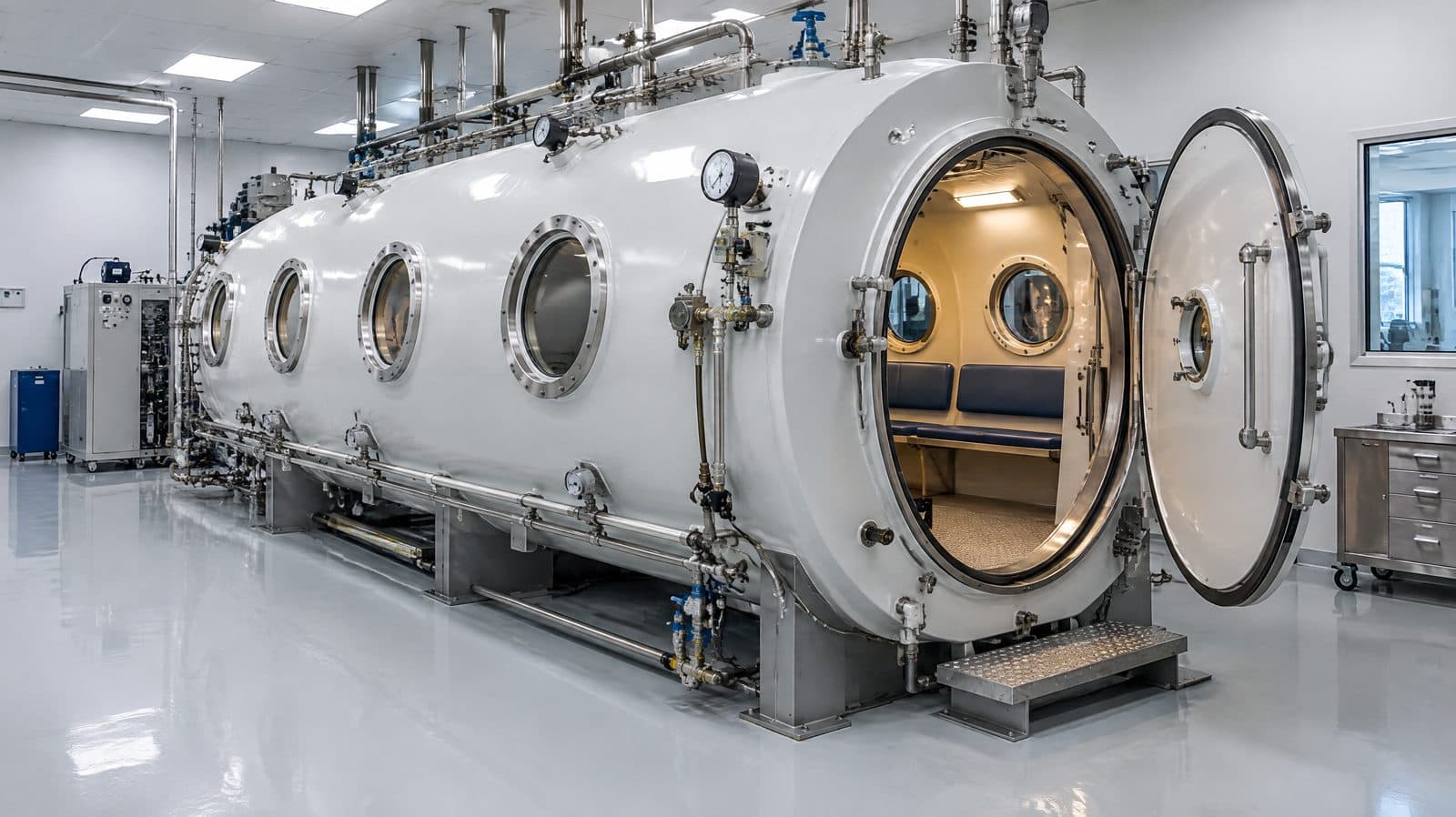
The Navy tables round their depths. Treatment Table 6, the standard treatment for decompression sickness and arterial gas embolism in the US Navy Diving Manual, chapter 17, starts at 60 fsw, which works out to 2.82 ATA and is quoted as 2.8 ATA. Table 6A allows compression as deep as 165 fsw, or 6 ATA. Many elective clinical protocols use Table 9 at 45 fsw, about 2.4 ATA.
Quick Formulas
- ATA = (gauge psi ÷ 14.696) + 1
- gauge psi = (ATA − 1) × 14.696
- ATA = (fsw ÷ 33) + 1
- ATA = (msw ÷ 10.13) + 1, or about (msw ÷ 10) + 1 for quick estimates
- kPa absolute = ATA × 101.325
Why Pressure Sets the Oxygen Dose
Dalton's law says the pressure of each gas in a mixture is its share of the total. The partial pressure of oxygen (PO2) is therefore the oxygen fraction multiplied by the absolute pressure. This is why pressure, not just oxygen concentration, determines how much oxygen dissolves in blood plasma under Henry's law, as described in the StatPearls review of gas laws.
| Chamber pressure (ATA) | PO2 breathing air (ATA) | PO2 breathing 100% oxygen (ATA) |
|---|---|---|
| 1.0 | 0.21 | 1.00 |
| 1.3 | 0.27 | not permitted in fabric chambers |
| 1.5 | 0.32 | 1.50 |
| 2.0 | 0.42 | 2.00 |
| 2.4 | 0.50 | 2.40 |
| 3.0 | 0.63 | 3.00 |
The Undersea and Hyperbaric Medical Society defines hyperbaric oxygen therapy as breathing near 100% oxygen in a chamber at 1.4 ATA or more, and every indication on its approved list requires at least 2.0 ATA. Its position statement on low-pressure fabric chambers notes that air at less than 1.4 ATA delivers no more oxygen than a mask at sea level. The table shows why: air at 1.3 ATA gives a PO2 of about 0.27 ATA, while breathing pure oxygen at sea level gives a PO2 of up to 1.0 ATA. The full list of approved conditions is on the UHMS indications page.
Higher pressure also means a higher risk of oxygen toxicity, which is why clinical protocols use the lowest pressure that does the job and add short air breaks to long oxygen periods.
Decoding Soft-Chamber Specifications
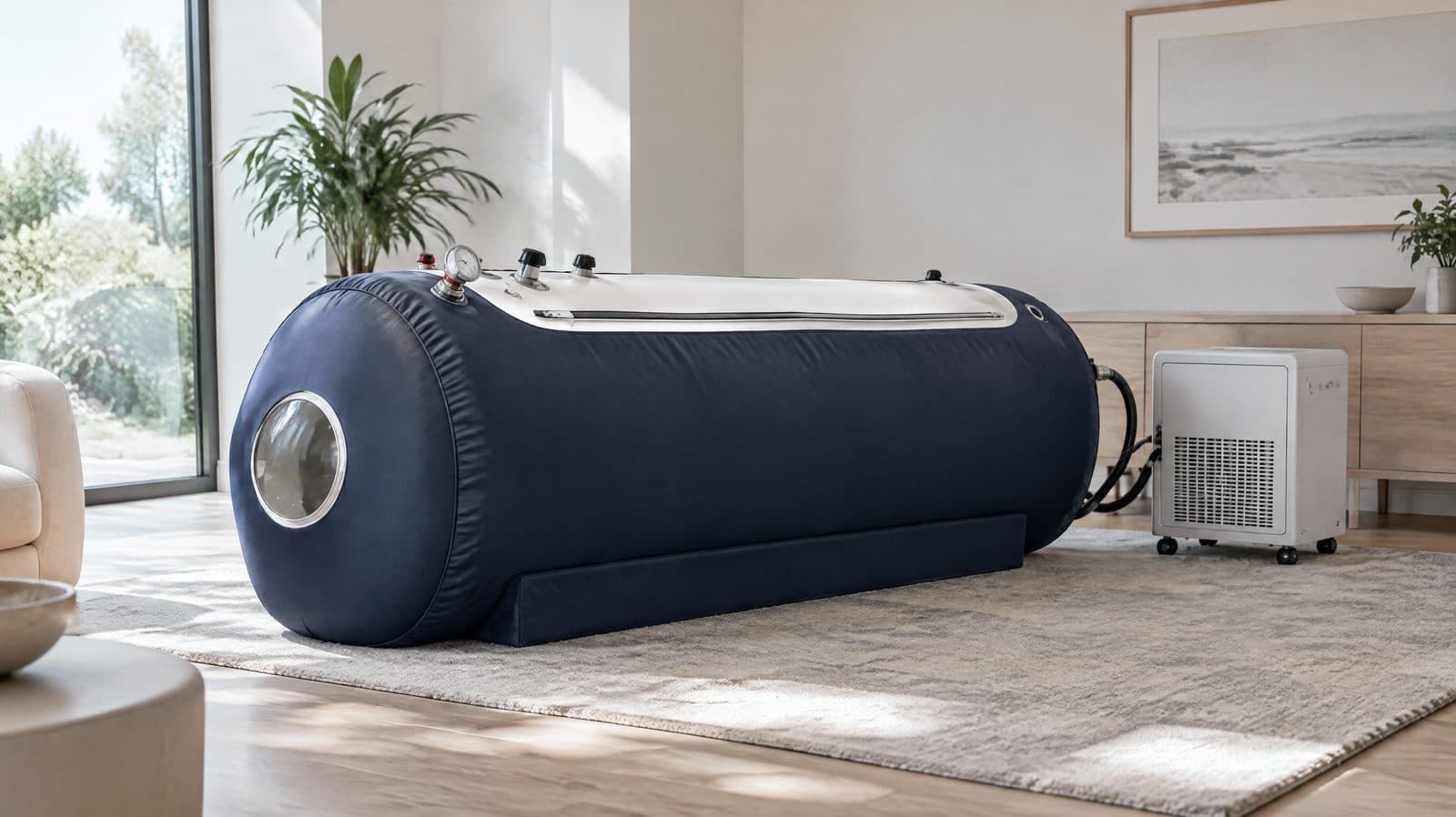
Fabric chambers are usually sold by their gauge pressure in psi. An FDA 510(k) summary for one such product line (K072757) describes chambers that "attain 1.3 ATA (4 PSI)" and are indicated for acute mountain sickness. Four psi is 0.27 atmospheres, so at sea level the absolute pressure is about 1.27 ATA.
Altitude changes the absolute number. The standard atmosphere model published by NASA Glenn Research Center gives an ambient pressure of about 83.5 kPa (0.82 atm) at 1,609 meters, the elevation of Denver. The same 4 psi chamber there sits at roughly 1.10 ATA absolute. Gauge pressure stays the same; the absolute pressure the body feels does not.
Pressure Thresholds in Regulation
- FDA device classification. Hyperbaric chambers are regulated as Class II medical devices under 21 CFR 868.5470.
- Pressure vessel standard. According to the UHMS position statement, the ASME PVHO-1 standard applies to any vessel that holds a person at more than 2 psig, about 1.14 ATA.
- Supplemental oxygen in fabric chambers. The same statement notes that the FDA clearance for these devices covers compression with air only.
Pressure and Gas Volume: Why the Ears Feel It First
Boyle's law links pressure and volume: at constant temperature, gas volume is inversely proportional to absolute pressure (see NASA's explanation of Boyle's law). Any gas trapped in the body shrinks as the chamber is compressed.
| Pressure (ATA) | Volume of trapped gas (vs sea level) |
|---|---|
| 1.0 | 100% |
| 1.3 | 77% |
| 1.5 | 67% |
| 2.0 | 50% |
| 2.4 | 42% |
| 3.0 | 33% |
Two-thirds of the volume change on the way to 2.0 ATA happens in the first half-atmosphere, so the relative change is steepest at the start. That is why ear discomfort appears early in compression and why operators compress slowly at first. Our page on middle ear barotrauma covers what happens when the ear cannot keep up, how often it occurs and how it is prevented.
Frequently Asked Questions
What does ATA stand for?
Atmospheres absolute: the total pressure, including the one atmosphere of air already pressing on us at sea level. A chamber at 2.0 ATA has twice the sea-level pressure inside it.
How many psi is 2 ATA?
2.0 ATA is one atmosphere above sea level, so the chamber gauge reads about 14.7 psi (psig). In absolute terms the inside pressure is about 29.4 psia.
Is 1.3 ATA the same as 4 psi?
Almost. 4 psi of gauge pressure is 0.27 atmospheres, so a fabric chamber inflated to 4 psi at sea level sits at about 1.27 ATA, which is marketed as 1.3 ATA. At altitude the absolute figure is lower because the starting pressure is lower.
Why do hyperbaric doctors talk about feet of seawater?
Hyperbaric medicine grew out of diving medicine. Treatment tables written by the US Navy are expressed as depths, so 60 fsw on a treatment table means the same pressure a diver would feel 60 feet under the sea, about 2.8 ATA.
Why is higher pressure not always better?
The oxygen dose rises with pressure, and so does the risk of oxygen toxicity and barotrauma. Protocols choose the lowest pressure that achieves the clinical goal, usually 2.0 to 2.4 ATA for elective treatments.
References
- National Institute of Standards and Technology. NIST Guide to the SI, Appendix B: Conversion Factors (SP 811). nist.gov
- Jones MW, Brett K, Han N, Cooper JS, Wyatt HA. Hyperbaric physics. StatPearls. NCBI Bookshelf. NBK448104
- StatPearls. Gas laws and clinical application. NCBI Bookshelf. NBK546592
- US Navy Diving Manual, Revision 7, Volume 5, Chapter 17: Recompression Chamber Operations. PDF
- Undersea and Hyperbaric Medical Society. Position statement: low-pressure fabric hyperbaric chambers (revised 2018). PDF
- Undersea and Hyperbaric Medical Society. Indications for hyperbaric oxygen therapy. uhms.org
- US Food and Drug Administration. 510(k) summary K072757 (Dive Series hyperbaric chambers). PDF
- 21 CFR 868.5470, Hyperbaric chamber. Electronic Code of Federal Regulations. ecfr.gov
- NASA Glenn Research Center. Earth atmosphere model, metric units. grc.nasa.gov
- NASA Glenn Research Center. Boyle's law. grc.nasa.gov
- Varughese L, O'Neill OJ, Marker J, Smykowski E, Dayya D. The effect of compression rate and slope on the incidence of symptomatic Eustachian tube dysfunction leading to middle ear barotrauma. Undersea Hyperb Med. 2019;46(2):95–100. PMID 31051053
This page is a general technical reference and is not medical advice. Treatment pressures are set by a qualified hyperbaric physician.
The most common pressure-related side effect, and how it is prevented.
Fabric and folding chambers, from Gamow bags to mild home units.
The diving injury behind the Navy treatment tables.