Monoplace vs Multiplace Hyperbaric Chambers: A Buyer's Comparison
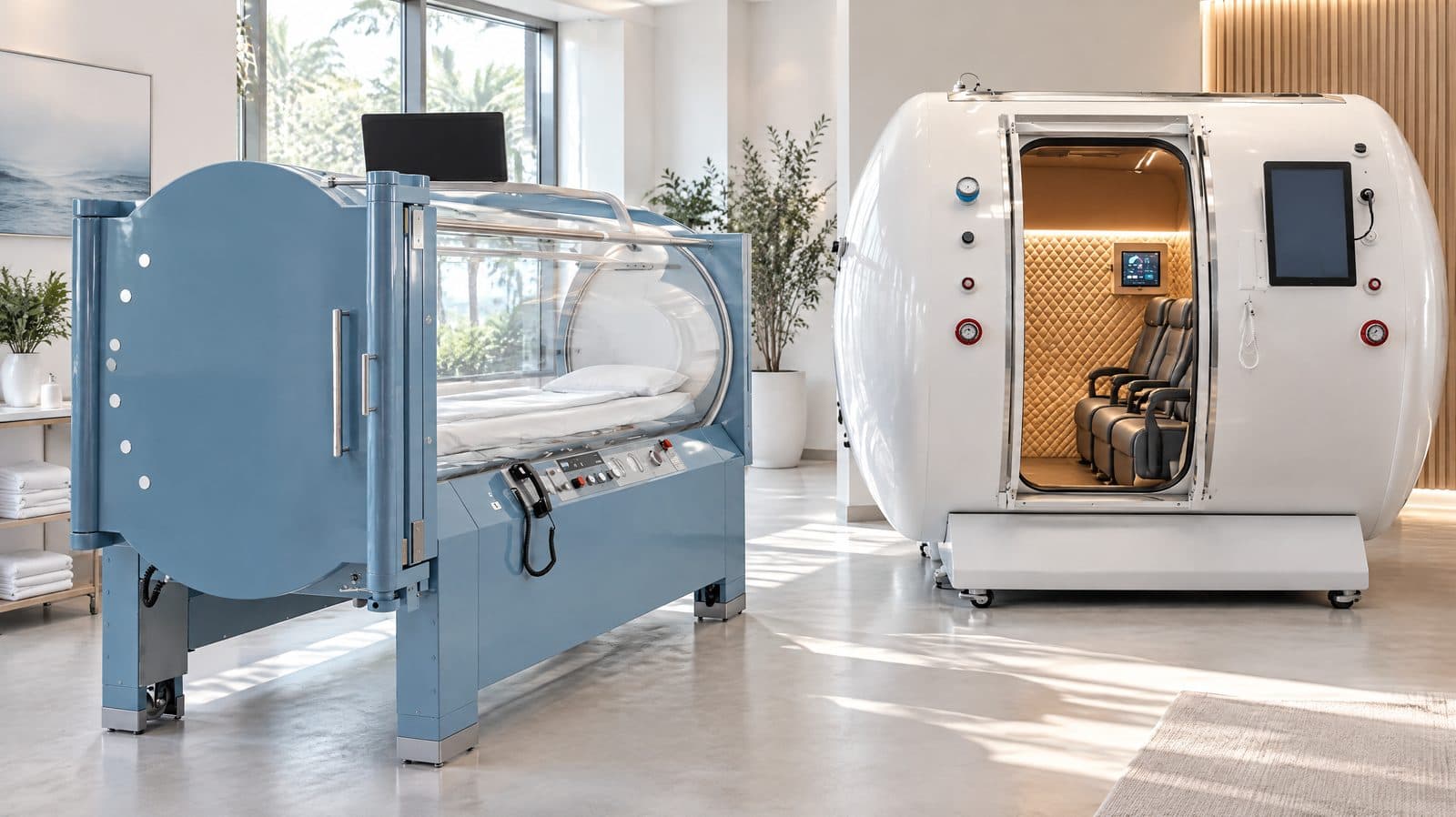
Every facility that buys a hyperbaric chamber makes one decision before it compares any brand or price: one patient per vessel, or several. The choice between a monoplace and a multiplace chamber fixes the staffing model, the room you need, the oxygen supply, the fire-safety regime and the revenue each session can produce. This page sets the two formats side by side for clinics, wellness centers and hospital departments that are deciding which to buy.
It is written as a reference for the purchase, not as a treatment guide. If you need background on the therapy itself, start with our overview of hyperbaric oxygen therapy. Note that the Undersea and Hyperbaric Medical Society (UHMS) accepts a fixed list of indications (fifteen headings in its current list, from air or gas embolism to avascular necrosis), and Medicare covers a similar list under National Coverage Determination 20.29. Most wellness and recovery uses fall outside that list, which matters for any business plan built on reimbursement.
Definitions
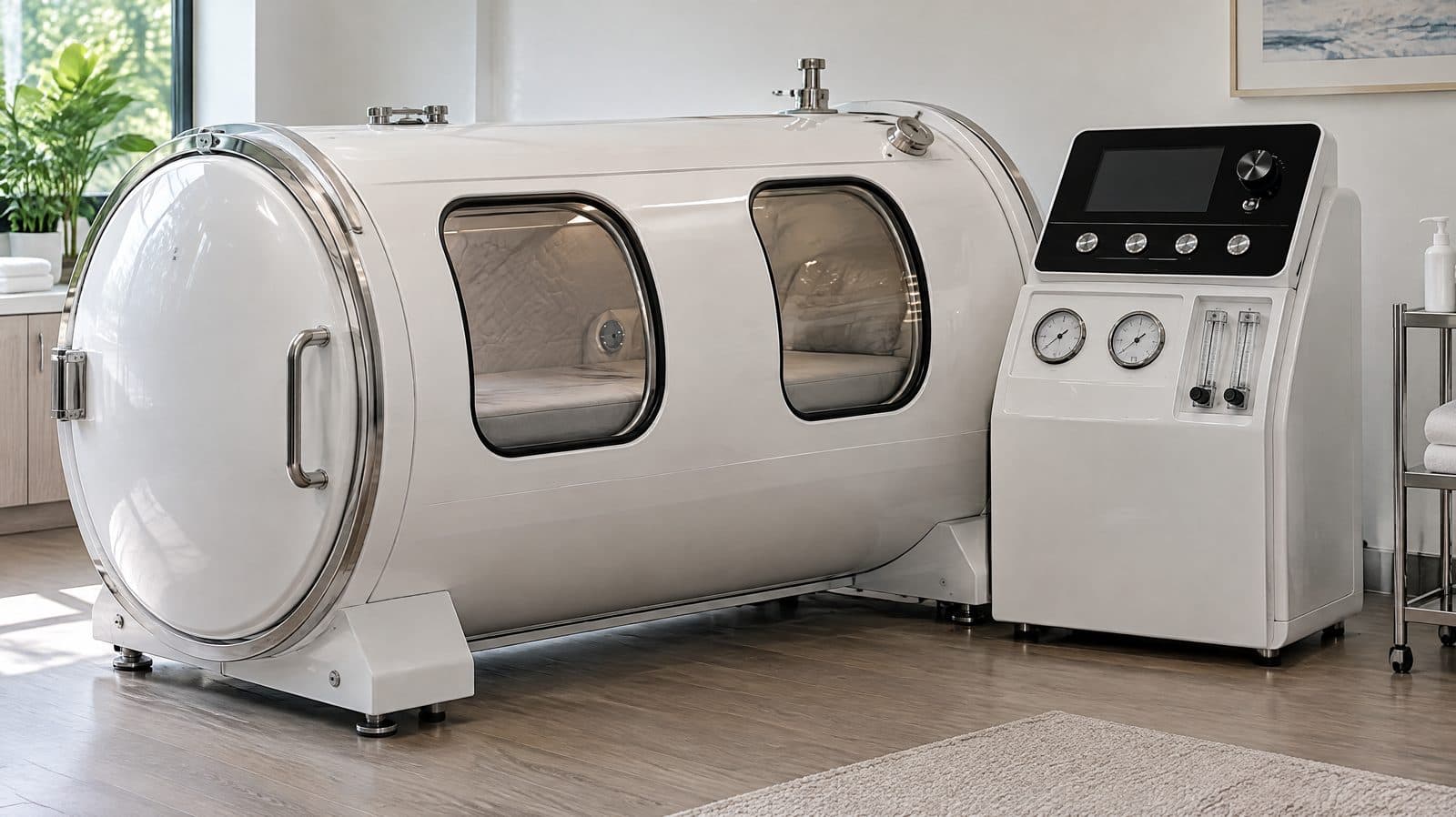
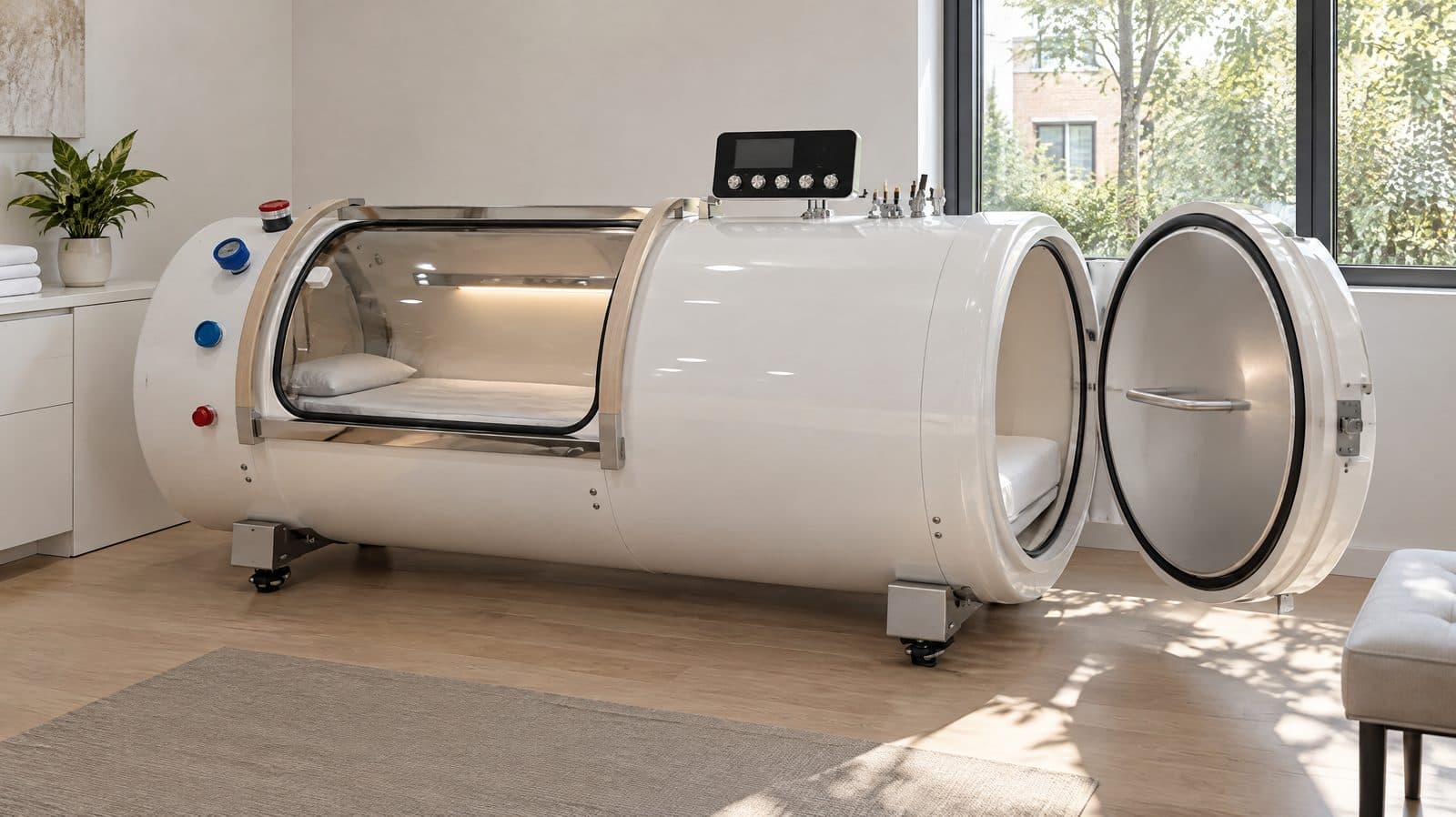
Monoplace chamber. A pressure vessel built for a single occupant. The classic hospital design is a clear acrylic cylinder on a gurney-style base, compressed with 100% oxygen so the patient breathes the chamber atmosphere directly. Steel and aluminum versions with viewports also exist. A newer group of compact rigid chambers for clinics and private buyers keeps the single-occupant format but is usually pressurized with air, with oxygen delivered by mask. Our monoplace chamber page covers the design history.
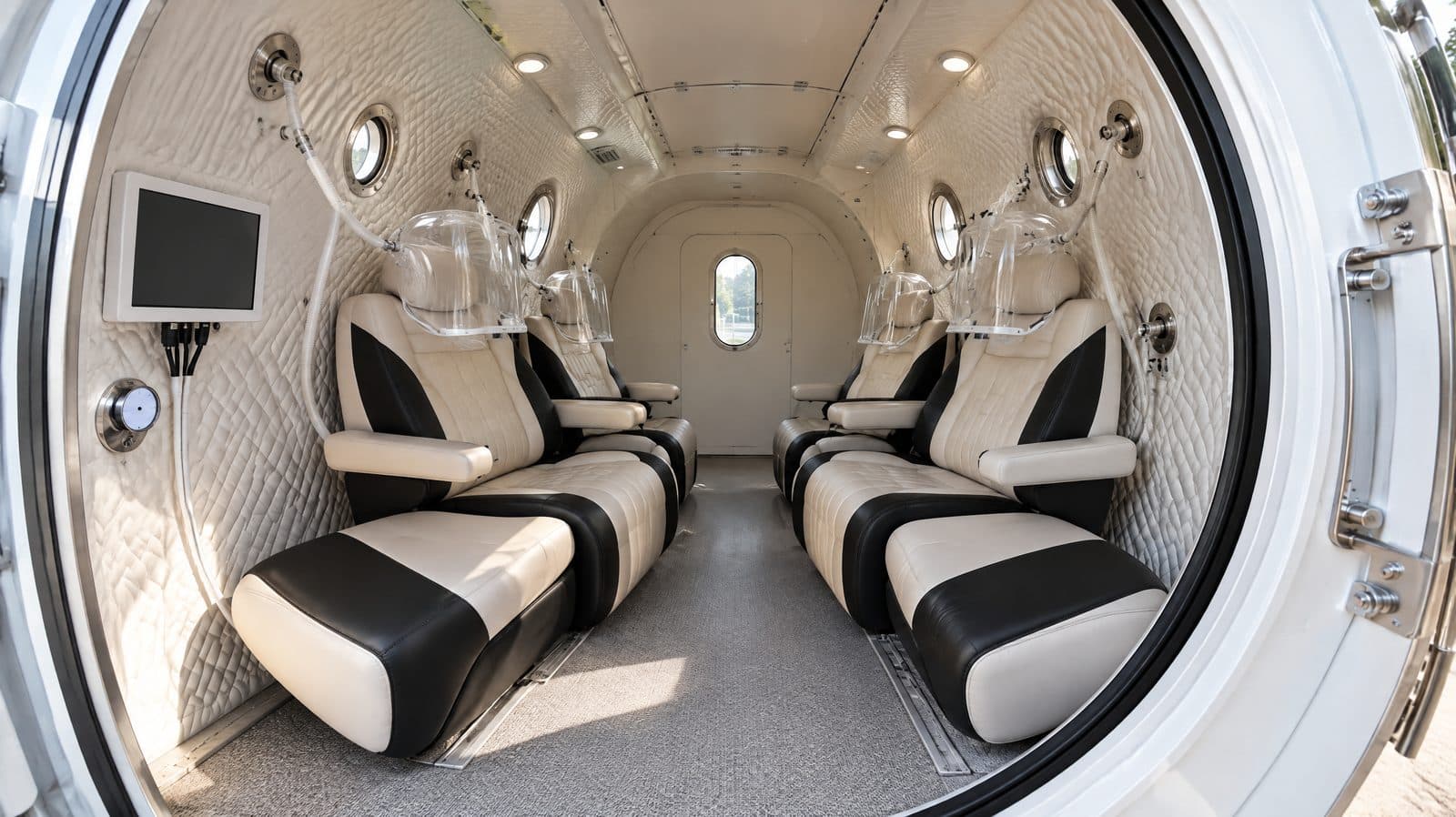
Multiplace chamber. A vessel that holds two or more people at the same pressure. It is always compressed with air, and each occupant breathes oxygen through a personal mask, hood or ventilator circuit. Hospital multiplace chambers are rectangular or cylindrical steel rooms with entry locks, so staff can enter or leave while the main compartment stays at pressure. They can run the deep treatment tables used for decompression illness. See our multiplace chamber page for examples.
The middle ground. Between a single acrylic tube and a twelve-seat hospital suite sits a small but growing class of compact multi-occupant vessels: two to four seats, about 2.0 ATA, sized for a treatment room rather than a plant room. These units muddy the old textbook comparison, and most of the decision scenarios below concern them.
The spread is wide even within one catalog. HPO TECH, a European maker, lists multiplace configurations with 2, 4 or up to 12 seats; its largest medical system is rated 3.0–6.0 ATA with 12 patient seats plus 2 for attendants, while its two-seat unit is listed at 2.0–3.0 ATA and its four-seat unit at 2.0 ATA. Many hospitals run both formats side by side. Penn Medicine's hyperbaric program, for example, operates one multiplace chamber with a staff member inside and two acrylic monoplace chambers, each with a nurse or paramedic stationed next to it for the whole treatment.
Side-by-Side Comparison
The figures below describe typical designs. Individual products vary, so check every number against the manufacturer's certification documents rather than its brochure.
| Factor | Monoplace | Multiplace |
|---|---|---|
| Capacity | One occupant per session. Throughput grows only by adding more chambers. | Two to four seats in compact commercial vessels; eight to twelve or more in hospital installations, often with an attendant inside. |
| Working pressure | Hospital units are typically rated to about 3 ATA, with most treatments run at 2.0–2.5 ATA. Compact rigid clinic units are usually rated 1.5–2.0 ATA; fabric units 1.3–1.5 ATA. | Hospital systems are built for deep treatment tables, up to about 6 ATA. Compact commercial multi-seat vessels generally operate at 2.0 ATA. |
| Chamber atmosphere | Classic clinical monoplace: the whole vessel is filled with 100% oxygen. Many compact rigid units are air-pressurized instead. | Always compressed air. Oxygen stays inside the breathing circuit and is not released into the room. |
| Oxygen delivery | Oxygen-filled units: none needed, the patient breathes the chamber gas. Air-filled units: mask or hood. | Individual mask, hood or (in hospitals) ventilator circuit per occupant, with an overboard exhaust for exhaled gas. |
| Staffing | One trained operator outside the vessel can supervise a session. No hands-on access to the patient while at pressure. | Operator at the control panel plus, in hospital practice, an inside attendant who is pressurized with the patients. Physician oversight for clinical work. |
| Footprint and utilities | Roughly a bed-sized vessel plus clearance. Oxygen-filled units need a bulk or piped oxygen supply and dedicated exhaust. | From a small-room footprint (compact units) to a purpose-built suite with compressors, air storage, fire suppression and plant room. |
| Purchase cost | Lowest entry price per vessel. Fabric units sit at the bottom; rigid single-seat units cost several times more. | Compact commercial units are priced in the low-to-mid six figures. Hospital multiplace systems are bought as construction projects with custom quotes. |
| Treatment profile | Each vessel runs its own pressure, duration and start time, so protocols can be set per patient. | Everyone in the chamber shares one pressure profile. Hospital chambers with entry locks can move staff or a patient in and out mid-session. |
| Patient types | Stable, cooperative patients who can lie still for the session. Ventilated or unstable patients need specialised monoplace equipment and staff. | Critically ill and ventilated patients, children with a parent, people with limited mobility, and clients who do not tolerate lying in a narrow tube. |
| Infection control | One occupant per cycle; the interior is cleaned between patients. | Shared air space and shared surfaces; masks and hoods are single-patient items and seats are cleaned between groups. |
| Regulation and standards | In the US, clinical HBOT devices are FDA Class II (510(k), product code CBF). Facility fire rules come from NFPA 99; vessels are commonly built to ASME PVHO-1. | The same device and vessel framework, plus heavier facility obligations: life-support systems, attendant safety, fire suppression and building-code review under NFPA 99. |
What the Table Does Not Show
Fire risk follows the atmosphere, not the seat count
An oxygen-filled monoplace puts the patient inside a 100% oxygen environment at elevated pressure, where ordinary materials burn far more readily. That is the reason for the strict rules on cotton clothing, grounding straps and banned personal items. The FDA's letter to health care providers on HBOT device safety reports serious injuries and deaths from chamber fires and asks facilities to follow the manufacturer's instructions, use proper grounding and keep staff training current. An air-filled multiplace, or an air-filled compact single-seat unit, keeps the oxygen inside the mask circuit. The fire hazard does not disappear, but it is a different engineering problem: oxygen levels inside the vessel have to be monitored and exhaled oxygen has to be vented overboard.
Hoods, masks and built-in breathing systems
In an air-filled chamber, oxygen delivery is the part clients notice. A clear hood seals at the neck and is easier for people who dislike pressure on the face, but it is warmer and noisier. An oronasal mask is lighter and lets the occupant read, but it has to fit well or room air leaks in and the delivered oxygen dose drops. Most multi-seat chambers use a built-in breathing system (BIBS): demand regulators at each seat that supply oxygen as the occupant inhales and dump exhaled gas outside the vessel. When you compare multi-seat units, ask how exhaled gas is removed, how chamber oxygen concentration is measured, and whether masks and hoods are supplied as single-patient consumables or must be bought separately.
Throughput is a staffing question
On paper, a four-seat vessel delivers four sessions per cycle and a monoplace delivers one. In practice, four monoplace units can run four staggered schedules with one operator watching several consoles. A multiplace runs everyone on the same schedule: the same start time, pressure and duration. That works well for a booked group or a block of similar clients. It works poorly for a mixed walk-in schedule, because one late arrival delays everyone, and a client who has trouble clearing their ears can force the whole chamber to slow down or stop.
Access to the patient
In a hospital multiplace, an attendant at pressure can manage an airway, suction a patient or respond to an oxygen-toxicity seizure in seconds. In a monoplace, staff have to decompress before they can touch the patient. For an intensive-care department this one point usually settles the question. For a wellness or sports-recovery business it rarely matters, because those clients are healthy and screened in advance.
Client experience
Claustrophobia is a common reason clients drop out, and it pushes in both directions. A clear acrylic monoplace gives an all-round view but a narrow space. A seated multi-occupant vessel gives more headroom and company, but clients have to wear a mask or hood for the whole session. Some clients prefer the shared session, while others will not breathe through a mask next to a stranger. If you can, let a sample of your actual clients try both formats before you sign.
Codes, permits and the paperwork trail
For US facilities, the hyperbaric chapter of NFPA 99, the Health Care Facilities Code sets requirements for chamber classification, ventilation, fire protection and electrical systems, and local fire marshals often apply it to clinics too. The FDA's classification entry for product code CBF lists the hyperbaric chamber under regulation 21 CFR 868.5470 as a Class II device reviewed through 510(k), flags it as life-sustaining or life-supporting, and names two recognized consensus standards: NFPA 99 (2021 and 2024 editions) and ASME PVHO-1, the safety standard for pressure vessels for human occupancy (2019 and 2023 editions). These apply to monoplace and multiplace vessels alike. A multiplace installation usually brings more of this work: structural review, compressor and air-quality testing, and a larger fire-suppression system. Ask any vendor, whatever the format, for the clearance number, the PVHO documentation and the name of the service engineer who will maintain the chamber.
Cost: What Can and Cannot Be Compared
Published prices only exist at the commercial end of the market. Hospital monoplace and multiplace systems are quoted per project, and the vessel is often a minority of the total once building works, oxygen or air plant, fire suppression and commissioning are added. For compact commercial chambers, list prices give a useful reference. As one example, Superhuman Chambers publishes “from” prices of $49,900 for its L1 and $79,900 for its X, both single-occupant 2.0 ATA hard-shell units. Its two-seat T2 starts at $99,900 and its four-seat T4 at $169,000, which the maker describes as all-inclusive. When you compare it with other rigid-chamber makers such as OxyHealth, Summit to Sea or Newtowne Hyperbarics, ask each for a written quote with the same scope (delivery, installation, training and first-year service), because headline prices rarely include the same items.
Those figures point to the real calculation. Per seat, a multi-occupant vessel can cost less than the same number of single-seat units. The saving only holds if you fill the seats. A four-seat chamber that runs half-full most of the day costs more per session delivered than two single-seat units running in parallel. Before choosing, model your expected occupancy honestly, by hour of day, and include installation, the annual service contract, insurance and staff time.
Decision Scenarios
1. Hospital department treating emergencies
Carbon monoxide poisoning, gas embolism and decompression sickness need deep treatment tables and hands-on care. Clinically, the chamber should be a multiplace with an inside attendant, sized for your referral volume. Monoplace units are often added alongside it for routine elective wound-care sessions, so that the large chamber stays free for emergencies.
2. Outpatient wound-care clinic
The US outpatient model is built on oxygen-filled monoplace units. Patients arrive at different times, each session follows its own protocol, and one technician can supervise several chambers. Unless you can reliably book patients into fixed group slots, a multiplace adds staffing cost without adding revenue.
3. Wellness center or med spa with a single treatment room
Here the question is mostly about space and scheduling. One rigid single-seat unit is the lowest-risk start: a smaller room, simpler staffing and no idle seats. If the room already has a booking waitlist, or clients usually come in pairs (couples, a parent and child, training partners), a compact two-seat vessel can double capacity per slot without doubling floor space. The T2's published footprint of 6 ft 10 in by 5 ft 5 in shows how small that class has become.
4. Sports team, performance center or physical therapy practice
Athletes train on a shared timetable and are used to group sessions, which suits a multiplace. A three- or four-seat unit can take a squad block after training in a fraction of the time a single monoplace would need. If you are weighing this route, look at a seated multi-occupant chamber design to see how the seating layout, mask delivery and in-chamber controls work in practice, then test the schedule against your actual training calendar.
5. Multi-site operator planning growth
Standardize on one format so staff training, spare parts and protocols transfer between sites. Single-seat chambers scale one vessel at a time and are easier to move or resell. Multi-seat vessels give better unit economics at sites with steady group demand. Many operators use both: single-seat units at smaller sites and a multi-seat vessel at the main site.
Questions to Put to Any Vendor
- What is the certified maximum working pressure, and which document shows it (510(k) number, PVHO-1 data report, CE certificate)?
- Is the vessel pressurized with air or oxygen, and what oxygen supply, exhaust and monitoring does the room need?
- What are the exact footprint, door clearance, floor loading and electrical requirements?
- Who installs, commissions and services the chamber in your region, and what are the response times?
- What training is included for operators, and is it documented in a way your insurer and fire marshal will accept?
- What warranty covers the shell, the compressor and the controls, and is it transferable on resale?
Frequently Asked Questions
Is a multiplace chamber safer than a monoplace?
Neither format is safe or unsafe by itself. An air-filled multiplace avoids a 100% oxygen atmosphere and lets staff reach a patient at pressure, which matters for unstable patients. An oxygen-filled monoplace has a smaller volume and one occupant, and decades of hospital use behind it. In both, safety depends on following the manufacturer's instructions, grounding, approved clothing, staff training and maintenance, the points the FDA stresses in its letter to providers.
Can a multiplace chamber run with only one person inside?
Yes. The pressure cycle, air use and operator time are the same whether one seat or every seat is filled, so a lightly used multi-seat chamber costs more per session than a single-seat unit doing the same work.
Do monoplace patients need a mask?
Not in a classic oxygen-filled monoplace: the patient breathes the chamber gas. In an air-filled single-seat chamber, oxygen comes through a mask or hood, just as in a multiplace.
Is a soft-shell chamber a monoplace?
It holds one person, but buyers and regulators treat fabric chambers as a separate class. They are rated to lower pressures (typically 1.3–1.5 ATA) and are usually pressurized with room air, so they should not be compared with rigid monoplace or multiplace vessels on clinical capability. Our portable chamber page covers them.
Will insurance pay for sessions in either format?
Coverage depends on the diagnosis and the program running the chamber, not on the chamber format. Medicare covers HBOT only for the conditions listed in NCD 20.29, and wellness or performance sessions are normally paid out of pocket.
Summary
Choose a monoplace when patients arrive individually, schedules vary and space is tight. Choose a multiplace when you need hands-on care at pressure or deep treatment tables, or when clients reliably arrive in groups. For most clinics the deciding factors are occupancy, staffing and the room, more than the hardware itself. Check the certification documents, model a realistic week of bookings, and let the format follow from those numbers.
This page is a general equipment reference and is not medical advice. Treatment decisions belong with a qualified hyperbaric physician.
Overview of chamber families, components and safety features.
Single-patient chambers: acrylic, steel and compact hard-shell designs.
Multi-patient chambers, attendants, entry locks and hospital systems.